Helping your body find its own balance, right by your side
We look beyond symptoms to your daily life and the flow of your whole body. Pulse diagnosis combined with Applied Kinesiology (AK) muscle testing helps us find the cause, and Dr. Kim Tae-hoon sees you personally from the first visit to the last.
AK muscle testingSpine & joint painStroke recoveryStress & Hwa-byungDigestionWomen's health
Dr. Kim Tae-hoonKorean Medicine Doctor · pen name Woobong (友峰)
“Sangsaeng” means a heart that helps others live. Just as the universe turns by the law of love, I believe healing means trusting the body’s own strength and helping it flow again.
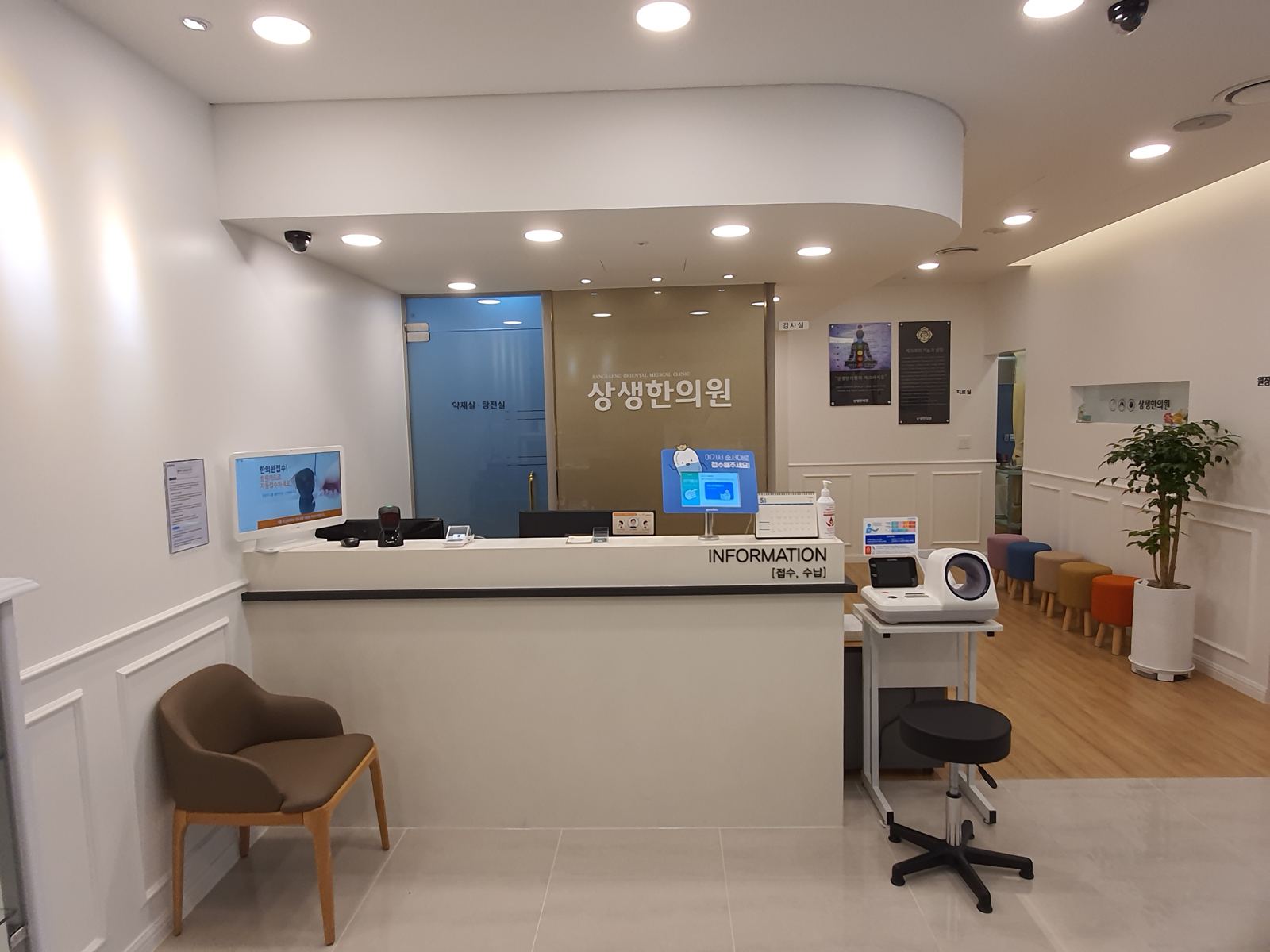
I first opened Sangsaeng Clinic in Gangjin, South Jeolla Province, in 2006 and moved to Gwanak-gu, Seoul, in April 2021. Years of caring for older patients with stroke after-effects and chronic pain are the foundation of my practice today.
2006Opened Sangsaeng Clinic in Gangjin, South Jeolla Province
2021.04Relocated to Bongcheon-dong, Gwanak-gu, Seoul
NowDirector of Academic Affairs, Gwanak-gu Association of Korean Medicine
Academic activities
Biweekly study meetingsMember, Dongui Jeongrihak Research Society
Active for four years, having completed the introductory, advanced and in-depth courses. The society carries on and develops Korea’s own Seondo (仙道) medical tradition.
Monthly seminarsMember, Korean Society of Applied Kinesiology
Refining AK practice through clinical case discussions and hands-on technique training.
The Sangsaeng clinic in Gangjin was handed over at the time of the move and is now a separate clinic run by another doctor.
What sets us apart · AK assessment
Reading the body’s signals through muscle response
AK · Applied Kinesiology
AK is an assessment system developed by Dr. George Goodheart in the United States in 1964. By checking how specific muscles hold against gentle pressure, we see which parts of the body are not working as they should.
AK sees health as a triangle in which structure, mind and chemistry (the internal organs) influence one another. Back pain, for example, may be tied not only to posture but also to food, medication or stress. We combine Korean medicine examinations such as pulse and abdominal diagnosis with AK muscle testing to set the direction of treatment.
Korean medicine exam
We first assess your constitution and overall condition through questioning, pulse and abdominal diagnosis.
AK muscle testing
Muscle responses reveal weakened areas and the related meridians and organs.
Tailored treatment
Chuna, acupuncture and myofascial release. For herbal medicine, each herb is selected one by one through muscle testing.
Re-test after treatment
Right after treatment we test the same muscles again and review the change together with you.
Member, Korean Society of Applied Kinesiology
Monthly seminars
Clinical case discussions
Hands-on technique training
01 / 05
Treatments
Structure, mind and chemistry: three paths of care
The same headache may come from the structure of the neck, built-up stress or digestion. Following the AK triangle of health, we look at all three together.
BodySTRUCTURE
Bones, joints, fascia and the nerves that run between them
Spine & joint pain
We realign the structure so that nerves are not compressed.
Neck pain
Low back pain
Knee pain
Shoulder & other joint pain
Jaw (TMJ) & teeth grinding
Brain & nerve recovery
Long-term care for what remains after brain or nerve injury.
Stroke after-effects
Parkinson's disease
Headache & dizziness after meningioma surgery
MindMIND
What emotion and stress leave on the body through the autonomic nervous system
Stress & Hwa-byung
Emotional burdens that show up physically: chest tightness, heat, palpitations.
Stress disorders
Hwa-byung (pent-up anger syndrome)
Insomnia
Anxiety & tension
Autonomic imbalance
Ear and head symptoms that arise when tension and relaxation fall out of balance.
Tinnitus
Vertigo & dizziness
Chronic fatigue
ChemistryCHEMICAL · ORGANS
How food, medicine and nutrition affect the internal organs
Digestion
Supporting the stomach and spleen so food moves down and is absorbed well.
Functional dyspepsia
Damjeok (phlegm stagnation)
Food stagnation
Women's health
Menstruation and hormones viewed within the balance of the whole body.
Irregular periods
Menstrual pain
Infertility
Metabolism · circulation · immunity
Regulating the flow of fluids and waste and the sensitivity of mucous membranes.
Weight management
Inflammatory swelling
Rhinitis
How we assess structure
The five factors of health in AK
For nerves to work well they must not be compressed, blood and lymph must flow, and the membranes around the nerves and the cerebrospinal fluid must be at ease. AK muscle testing shows which of the five is involved, and treatment is matched to it.
Nerve compression
Nerves pressed directly at the openings between vertebrae (intervertebral foramina)
Chuna · spinal adjustment
Neurolymphatic
Blocked lymph flow lowering nerve function
Lymphatic reflex points
Neurovascular
Reduced blood flow leaving nerves short of oxygen and nutrients
Circulation · vascular reflex points
Dural system
Tension and stiffness in the membrane around the nerves (dura)
Craniosacral therapy · dural release
CSF & energy
Disturbed cerebrospinal fluid flow and energy balance
Craniosacral therapy · energy balance
Causes differ from person to person. An accurate diagnosis requires an in-person examination.
Health column
Woobong’s Healing Notes
Dr. Kim (pen name Woobong) writes about healing body and mind: meridians, breathing, the autonomic nervous system, posture and meditation. Read the columns below; videos and the blog are in Korean.
NEWStress & nervous system2026.106 min read
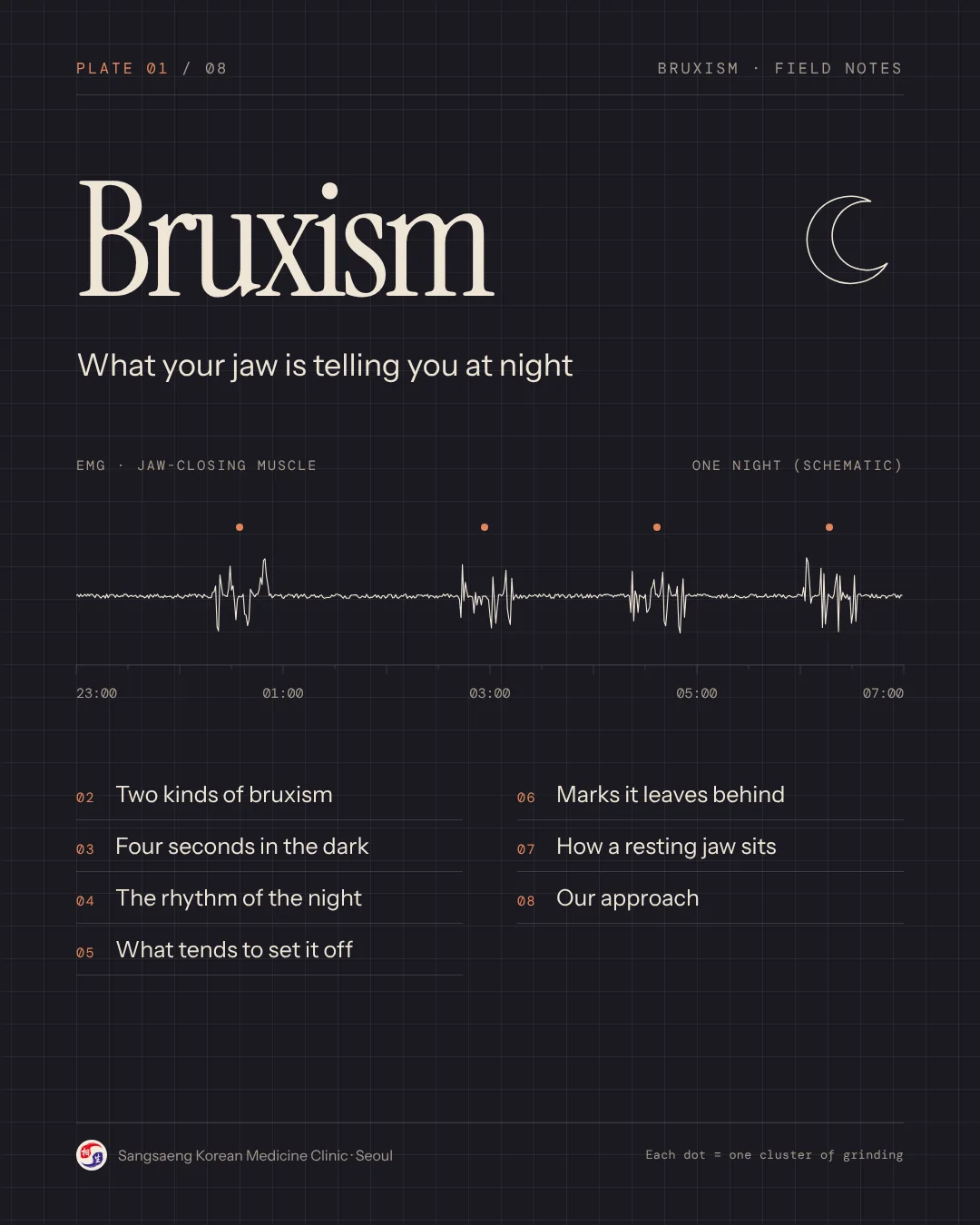
Why do we grind our teeth at night?
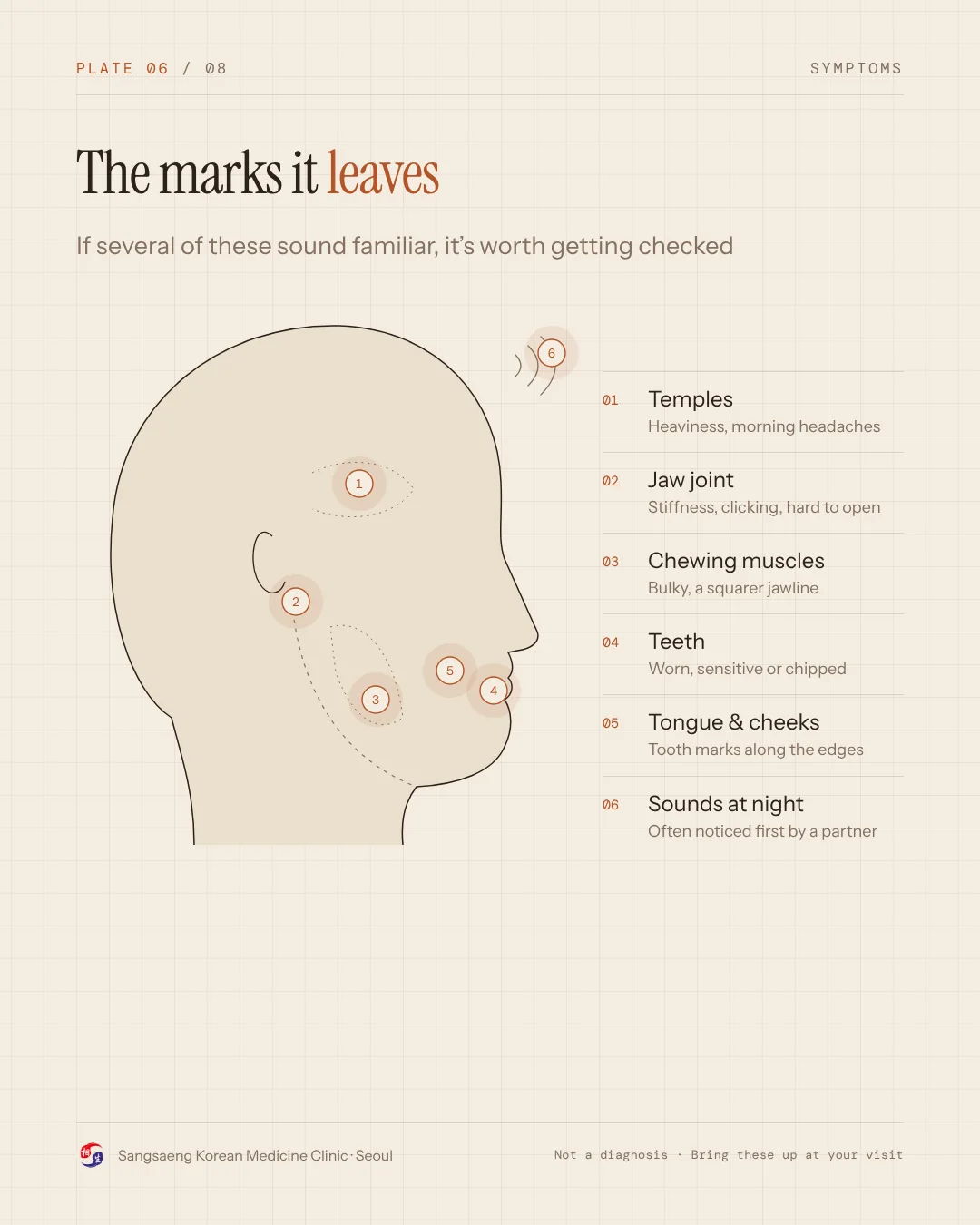
Waking up with a sore jaw or a dull ache in your temples? Has your partner told you that you were grinding your teeth all night? Your jaw muscles may be working overtime while you sleep.
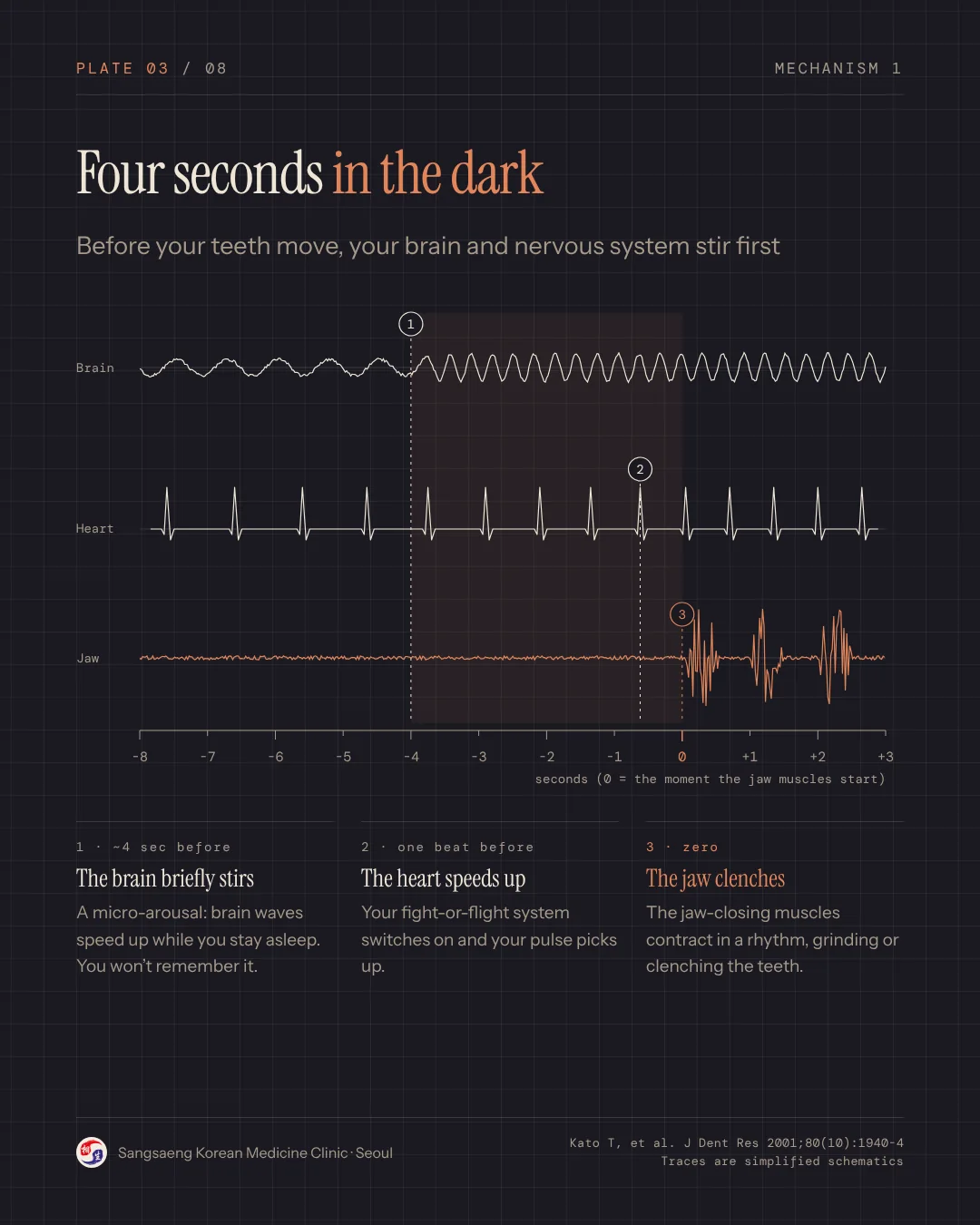
~4 sec before
Micro-arousalYour brain briefly stirs
You stay asleep, but your brain waves flicker toward waking for a moment. You won’t remember it.
Just before
Stress responseYour heart rate jumps
Your body’s fight-or-flight system switches on and your pulse picks up.
It begins
GrindingYour jaw clenches
The muscles that close your jaw contract in a rhythm, grinding or clenching your teeth.
How grinding starts during sleep. Sleep studies of people who grind their teeth show a brief brain arousal about four seconds before the jaw muscles kick in, with the heart speeding up just beforehand (Kato et al., 2001). In other words, grinding usually starts in the brain and nervous system, not in the teeth.
At a glance · 8 infographicsSwipe through; tap any image to enlarge
Read the full column
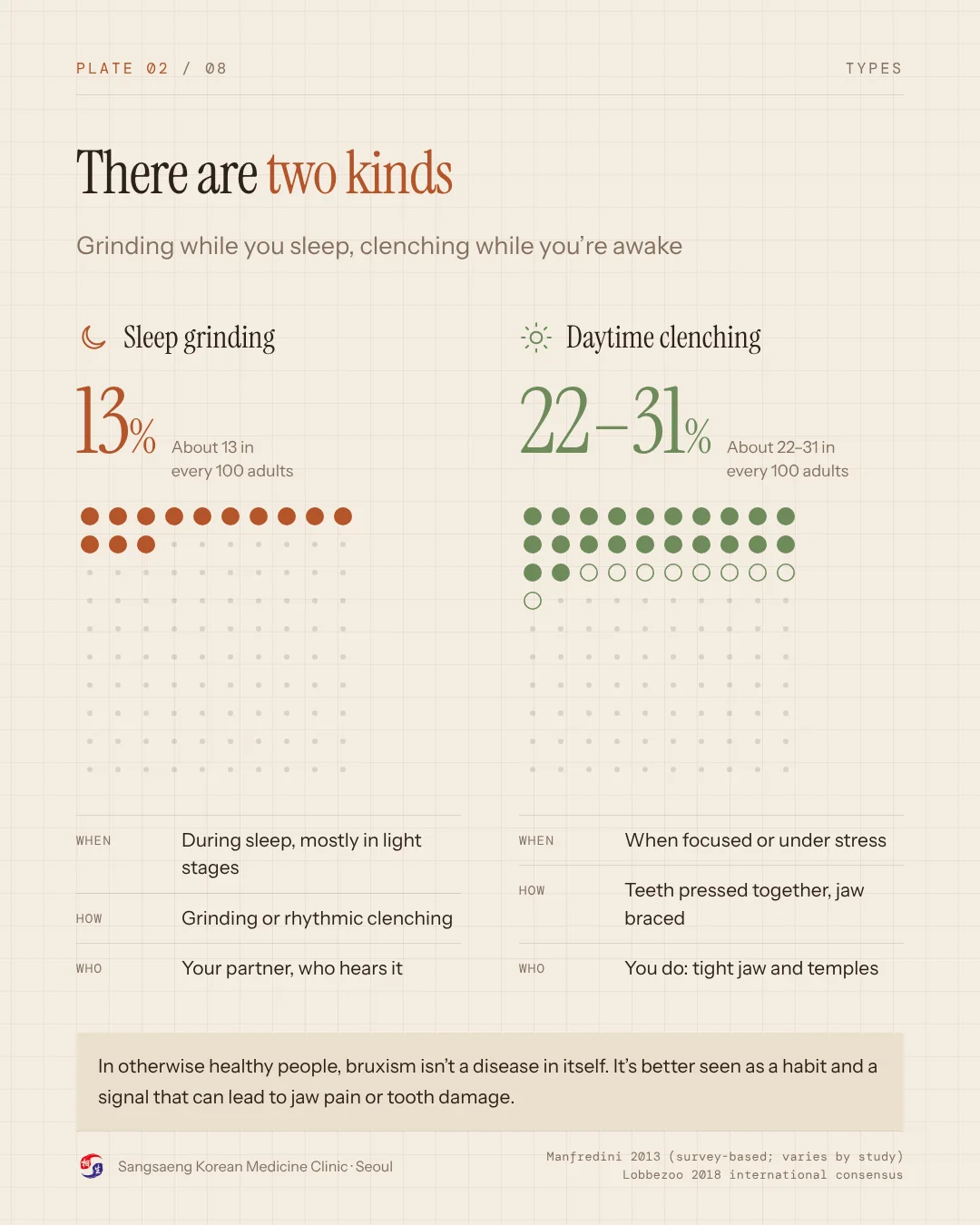
Night-time grinding vs. daytime clenching
Experts now distinguish between two types: sleep bruxism, which happens while you sleep, and awake bruxism, the clenching you do during the day (Lobbezoo et al., 2018). In otherwise healthy people, bruxism isn’t considered a disease in itself. It’s better thought of as a habit, and a signal from your body, that can lead to problems such as jaw pain or damaged teeth.
Night-time grinding
When it happens
During sleep, mostly in the lighter stages
What it looks like
Grinding or rhythmic clenching
Who notices
Usually your partner, who hears it
How common
About 13% of adults
Daytime clenching
When it happens
While concentrating or under stress
What it looks like
Teeth pressed together or the jaw held tight
Who notices
You do: a tight jaw and tense temples
How common
About 22–31% of adults
Two kinds of bruxism. These figures come from questionnaire surveys, so estimates vary widely from study to study (Manfredini et al., 2013).
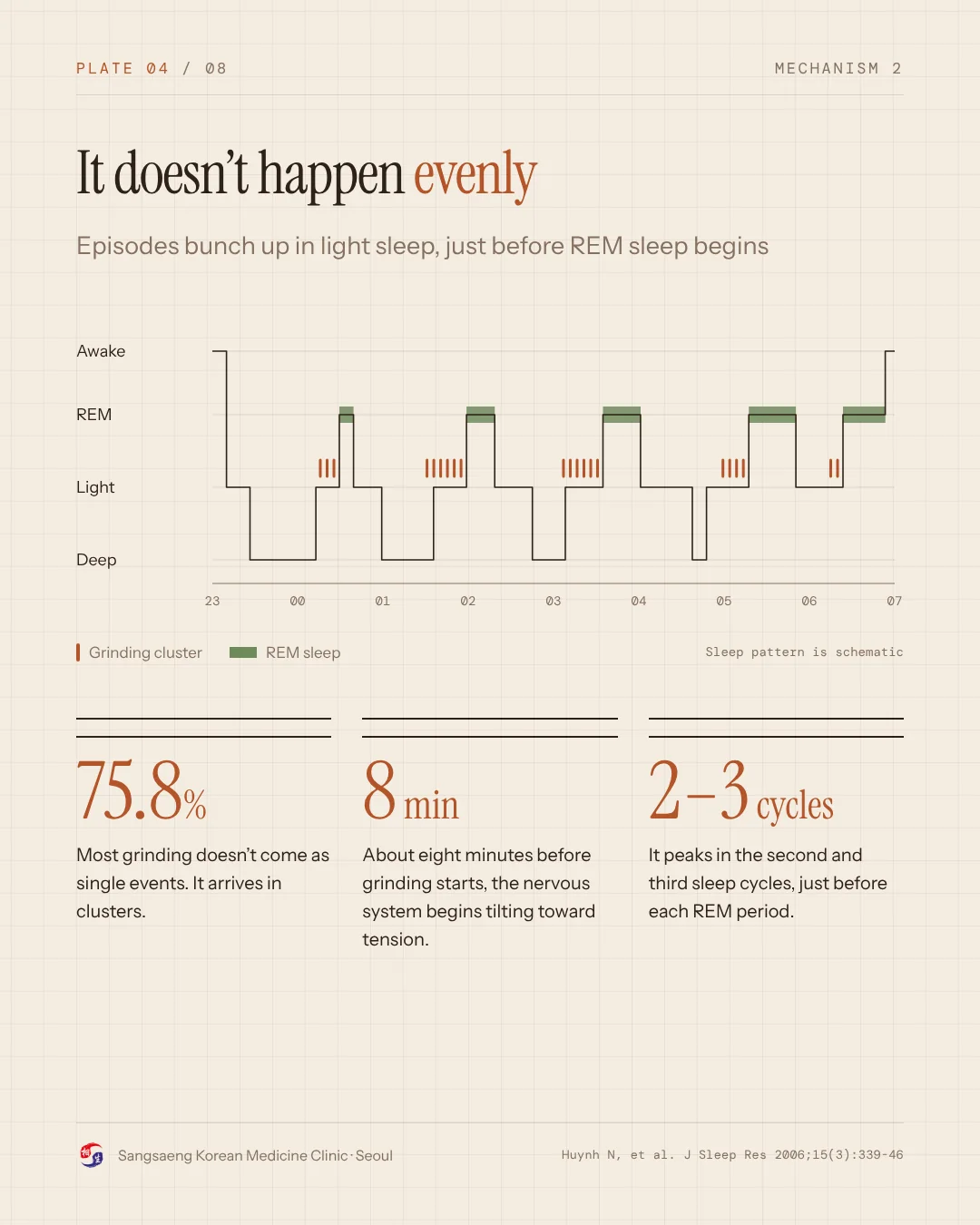
What’s going on while you sleep?
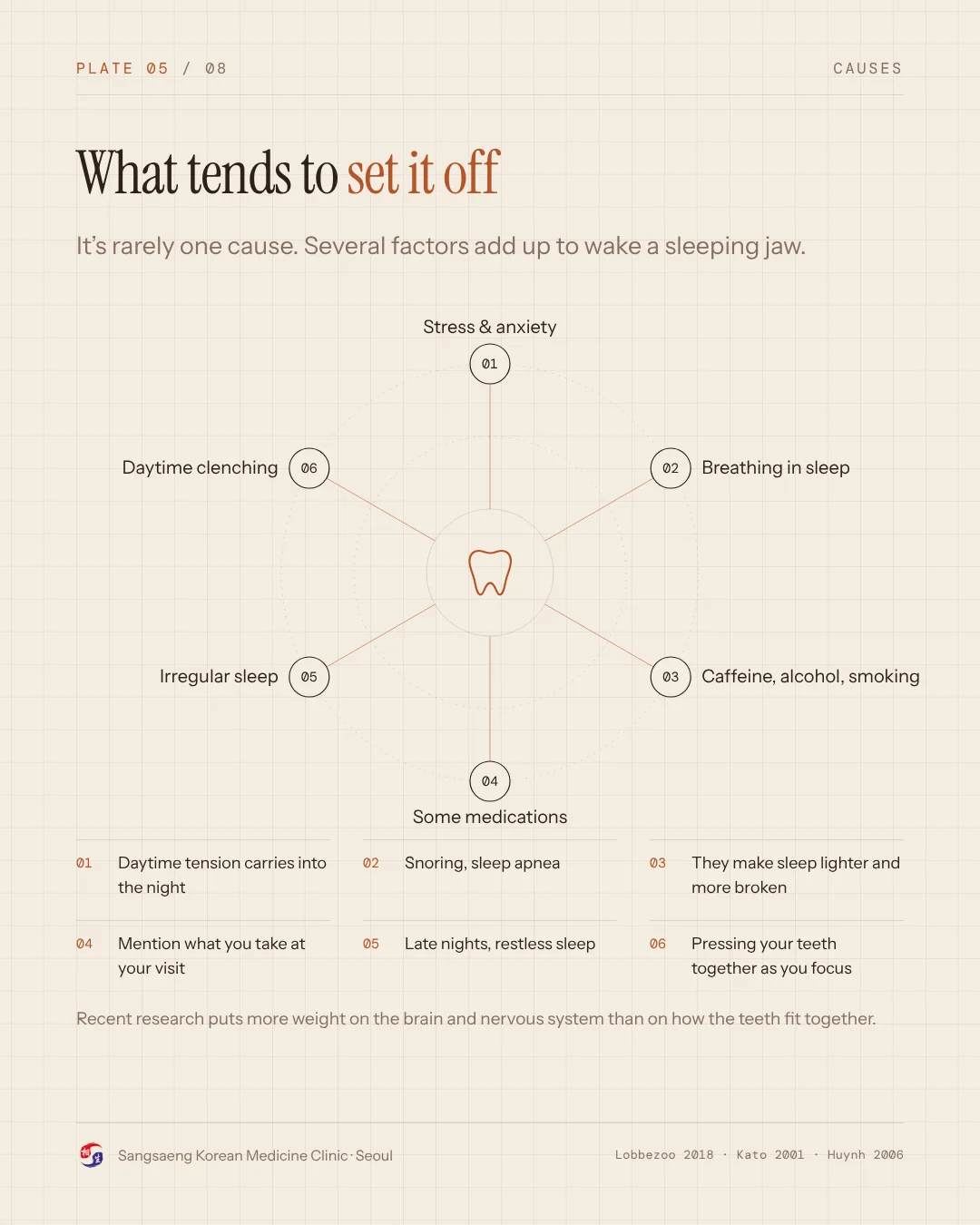
Night-time grinding usually isn’t caused by teeth that don’t fit together properly. As the diagram above shows, it’s more often the jaw reacting to brief moments when the brain and nervous system stir. That’s why it’s often linked to stress and anxiety, breathing problems during sleep (snoring and sleep apnea), caffeine, alcohol, smoking and certain medications. The more your daytime tension disrupts your light sleep at night, the harder your jaw ends up working.
Do any of these sound familiar?
Signs checked0 / 6Tap any that apply to you.
This isn’t a diagnosis. It’s simply a list of signs worth mentioning at your appointment.
Simple things you can start today
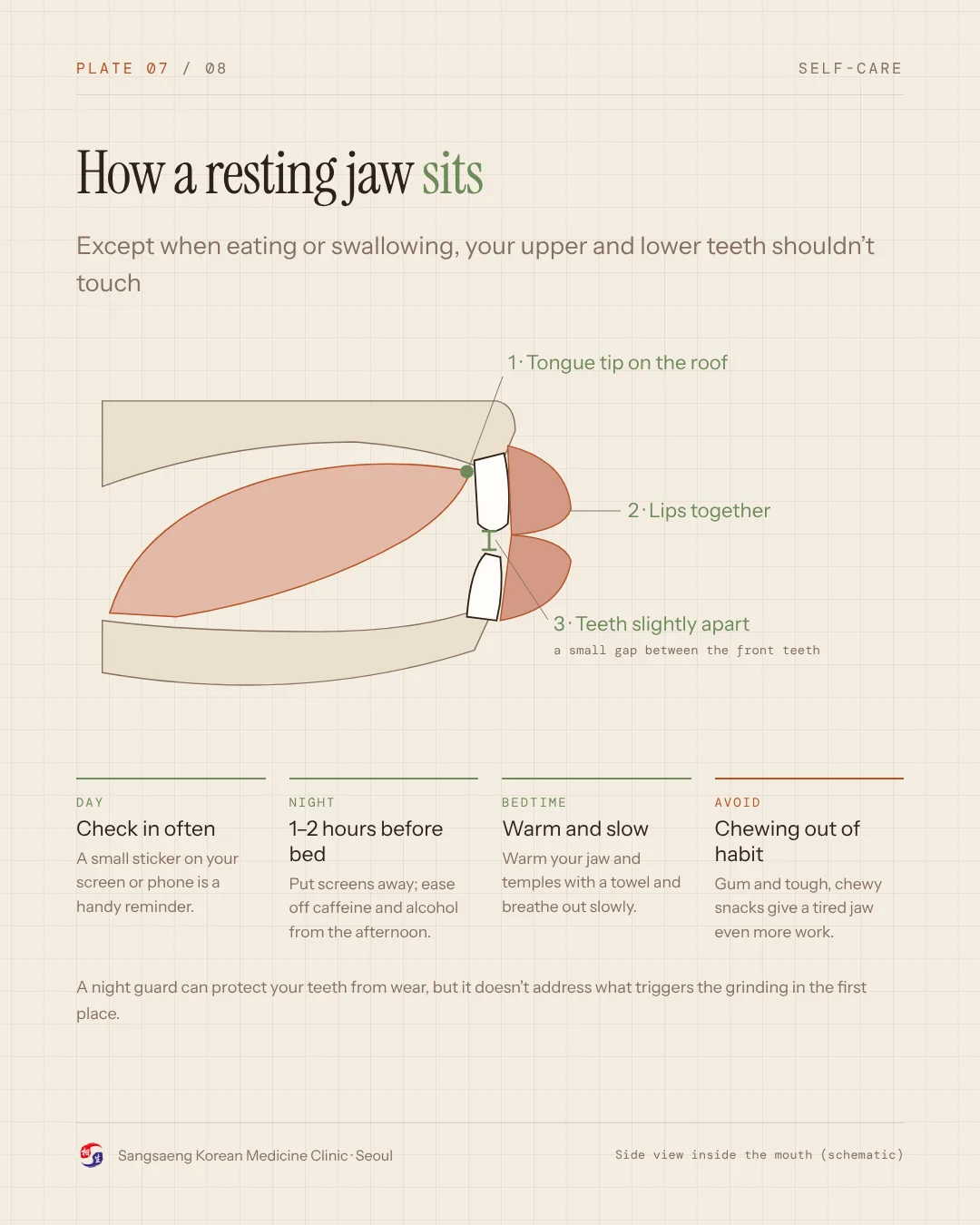
TryThroughout the day, check in with yourself: lips together, teeth apart, tongue resting on the roof of your mouth. A small sticker on your screen or phone makes a handy reminder.
TryPut screens away an hour or two before bed, and cut back on caffeine and alcohol from the afternoon onward.
TryAt bedtime, warm your jaw and temples with a warm towel, then breathe out slowly and let your shoulders and jaw go loose.
AvoidChewing gum or tough, chewy snacks out of habit. They give already tired jaw muscles even more work.
Relaxed
Clenched
Lips together, teeth apart, tongue up. Except when you’re eating or swallowing, your upper and lower teeth shouldn’t touch. If they meet while you’re just sitting still, your jaw is holding on to tension.
A night guard (splint) can protect your teeth from wear, but it doesn’t address what triggers the grinding in the first place.
Our approach at Sangsaeng Korean Medicine Clinic
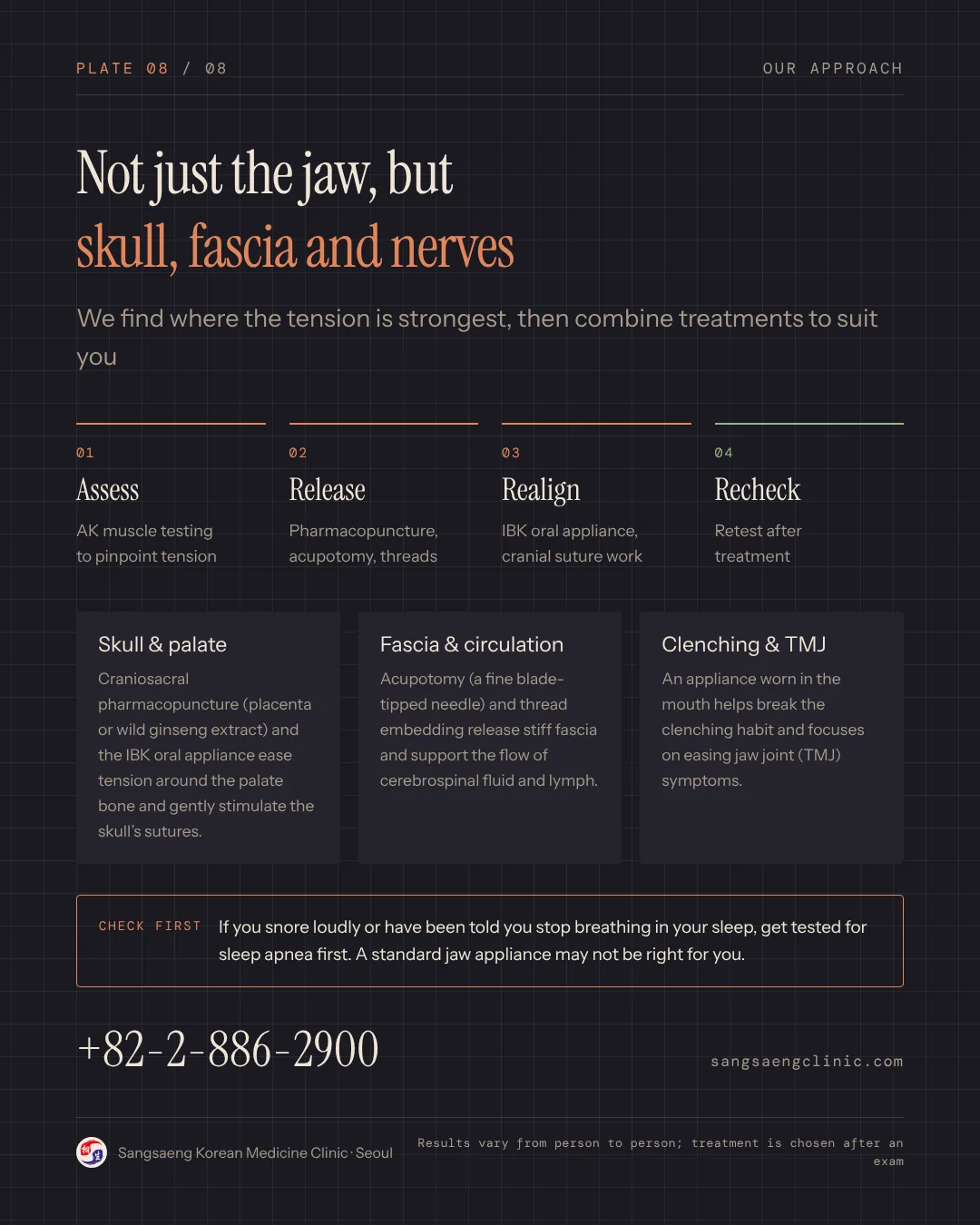
We don’t see bruxism as just a jaw problem. We see it as a sign that the skull, the connective tissue (fascia) around it and the nervous system are all holding tension together. We first use applied kinesiology (AK) muscle testing to find where that tension is strongest, then combine the treatments below to suit you.
Releasing the palate and the skull’s suturesWe use craniosacral pharmacopuncture (small amounts of placenta or wild ginseng extract injected at specific points) together with the IBK oral appliance to ease tension in the tissue around the palate bone. We also gently stimulate the joints between the skull bones, called sutures, to help them move more freely.
Loosening stiff fascia and improving circulationWe use acupotomy (a fine needle with a tiny flat blade at its tip) and thread embedding (fine, dissolvable threads placed under the skin) to release stiff fascia and support the flow of cerebrospinal fluid and lymph.
Easing clenching and jaw joint problemsAn appliance worn in the mouth helps break the clenching habit, with a focus on easing the range of symptoms that come with jaw joint (TMJ) disorders.
AssessAK muscle testing to pinpoint tension
ReleasePharmacopuncture, acupotomy and thread embedding to loosen fascia
RealignIBK oral appliance and gentle work on the skull’s sutures
RecheckRetest after treatment
Get these checked first: If you snore loudly or have been told you stop breathing in your sleep, get tested for sleep apnea before anything else, as a standard jaw appliance may not be right for you. See a dentist if a tooth chips or feels loose, and have your jaw examined first if it won’t open fully or gets stuck.
References · Kato T, et al. J Dent Res 2001;80(10):1940-4. · Manfredini D, et al. J Orofac Pain 2013;27(2):99-110. · Lobbezoo F, et al. J Oral Rehabil 2018;45(11):837-44.
This column offers general health information and is not a substitute for personal medical advice, diagnosis or treatment.
Posture & alignment2026.105 min read
When the front of your shoulder hurts as you raise your arm
If the front of your shoulder catches or twinges when you reach for a shelf, put on a shirt or wash your hair, it is worth checking whether the “ball” of the joint has slipped forward from where it belongs.
A right shoulder seen from above. When the back of the joint capsule shortens and the front support weakens, the ball (head of the upper-arm bone) is pushed forward of its usual place (dotted circle) and irritates the tendon at the front of the shoulder.Read the full column
The shoulder is a ball-and-socket joint
The shoulder (glenohumeral) joint is made of a round ball, the head of the upper-arm bone, resting on a shallow dish on the shoulder blade called the glenoid. The shallow dish lets the arm move widely in every direction, but it also means that ligaments, the joint capsule and the rotator cuff muscles must constantly hold the ball in place.
What happens when the ball slides forward
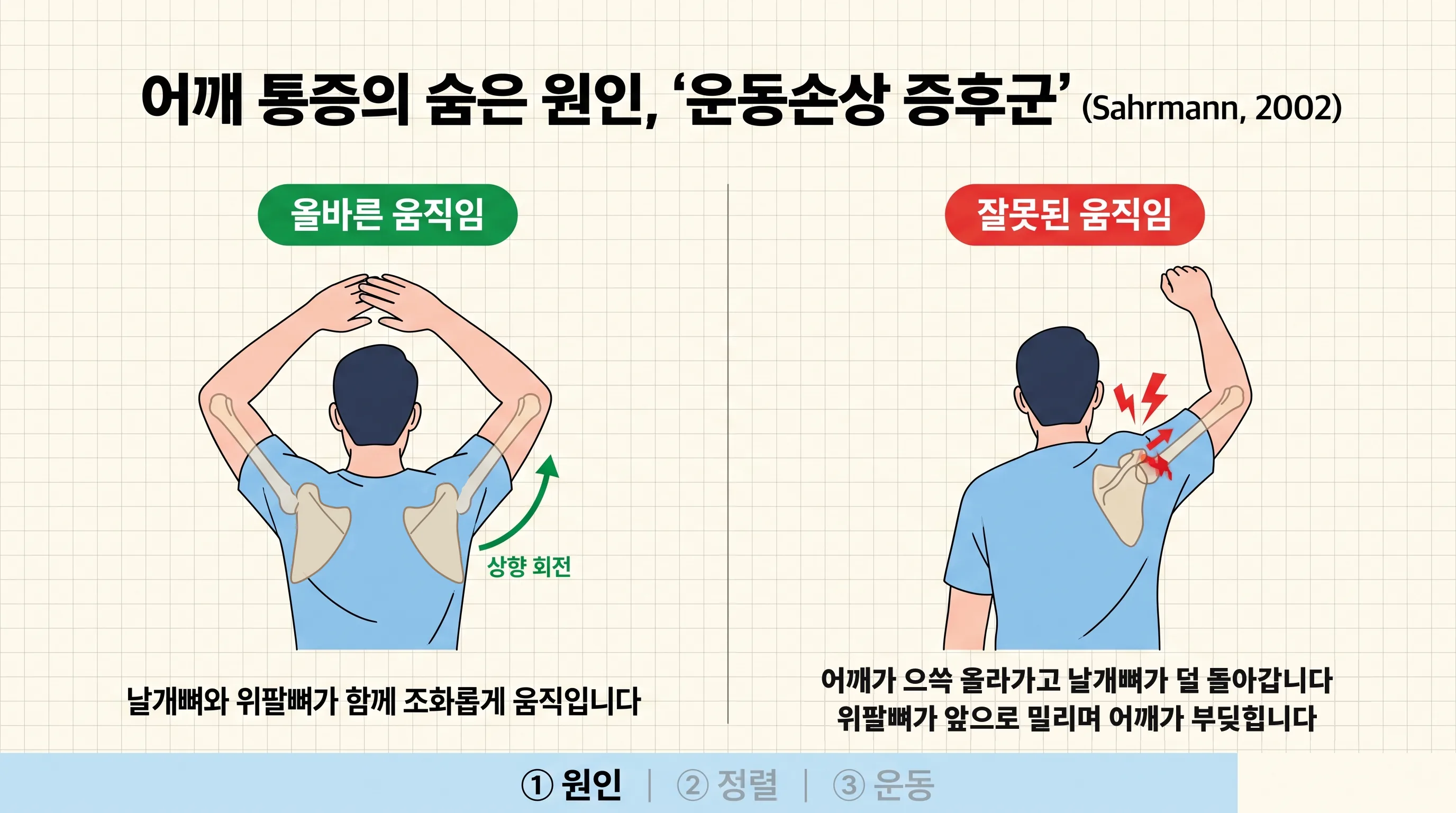
When the capsule and muscles at the back become short and stiff, or the ligaments and muscles supporting the front weaken, the head of the upper-arm bone glides toward the front of the socket as the arm moves. In movement rehabilitation this is called humeral anterior glide syndrome; in Korean medicine clinics it is often described as an anteriorly displaced humeral head.
The ball that has moved forward repeatedly irritates the long-head tendon of the biceps and the front of the capsule. That is why you may feel a deep ache or catching at the front of the shoulder when lifting your arm forward or to the side, or when putting your hand behind your back. At first it may hurt only in certain movements, but over time it can ache even at rest.
① Cause · movement impairment syndrome. If the shoulder blade does not rotate enough as you lift your arm, the shoulder hikes up and the head of the upper-arm bone is pushed forward, pinching the front of the shoulder. Tap the image to enlarge (text in Korean).
Who tends to get it
People who sit for long hours at a monitor or phone with a rounded back and shoulders rolled forward
People who enjoy exercises that draw the elbows far behind the body, such as bench presses and push-ups
People who always sleep on one side or carry a heavy bag on the same shoulder
People who have injured or dislocated the shoulder before
What to check in the mirror
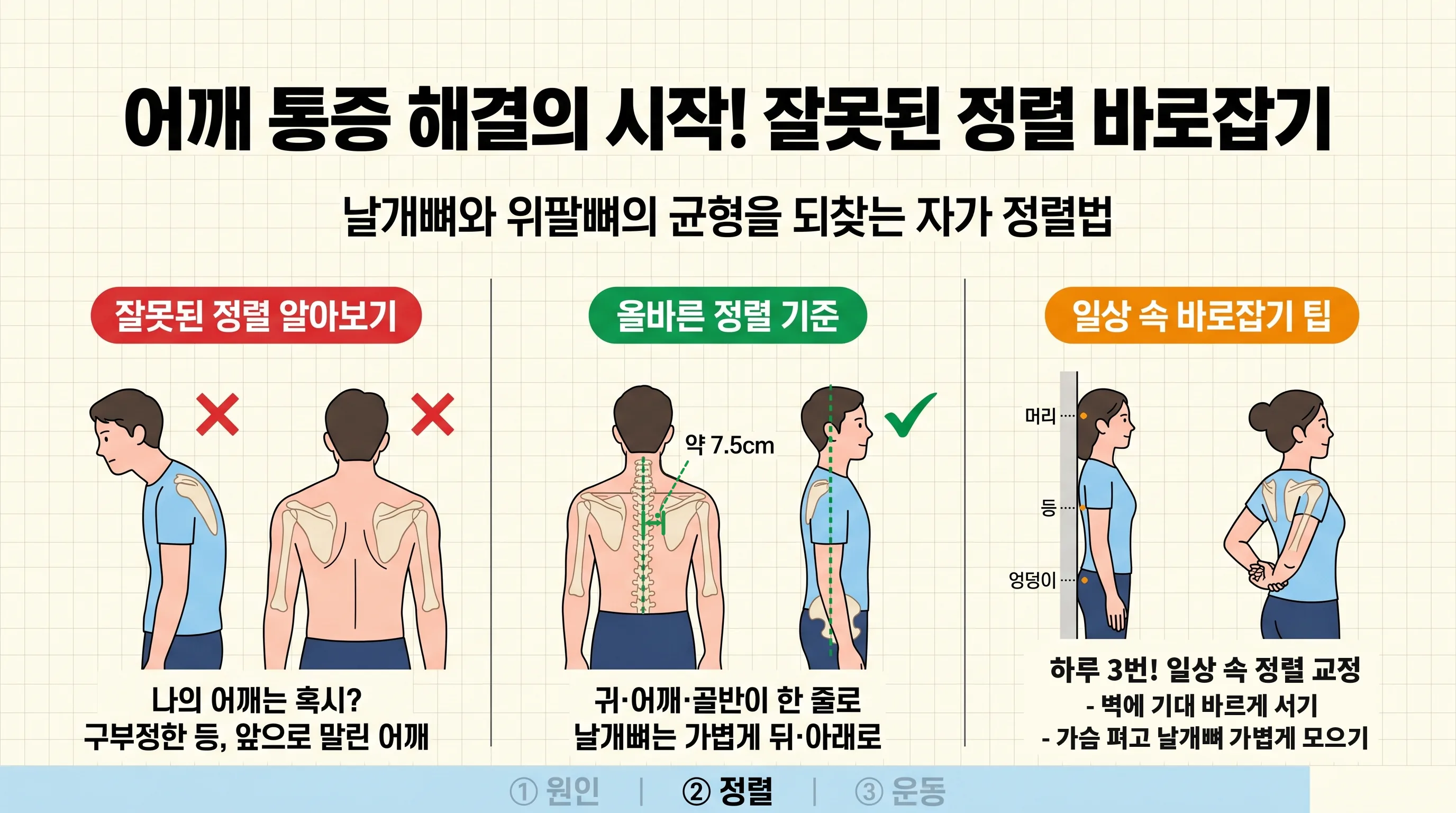
Stand side-on with your arms relaxed and see whether the front tip of your shoulder sits noticeably ahead of a line dropped from your earlobe. Also check whether the front of the shoulder hurts as you slowly raise your arm forward with the palm facing forward. This is only a clue, though. Rotator cuff injuries and frozen shoulder (adhesive capsulitis) cause similar pain, so an examination is needed to tell them apart.
Standing side-on to a mirror. Let your arms hang and imagine a straight line from your earlobe to the floor. If the tip of your shoulder sits clearly in front of that line, your shoulders may be rolled forward.② Alignment · ears, shoulders and pelvis in one line. The inner edge of the shoulder blade should sit about 7.5 cm from the spine, resting slightly back and down. Try standing against a wall and opening your chest three times a day. Tap the image to enlarge (text in Korean).
What you can do day to day
DoOpen your chest slightly when sitting and raise the screen to eye level.
DoWhen exercising, shorten the range so your elbows do not go far behind your body.
DoWhen lying on your back, place a thin towel under the elbow, and avoid lying on the painful side for long.
AvoidForcing stretches through pain. They can push the forward ball even further forward.
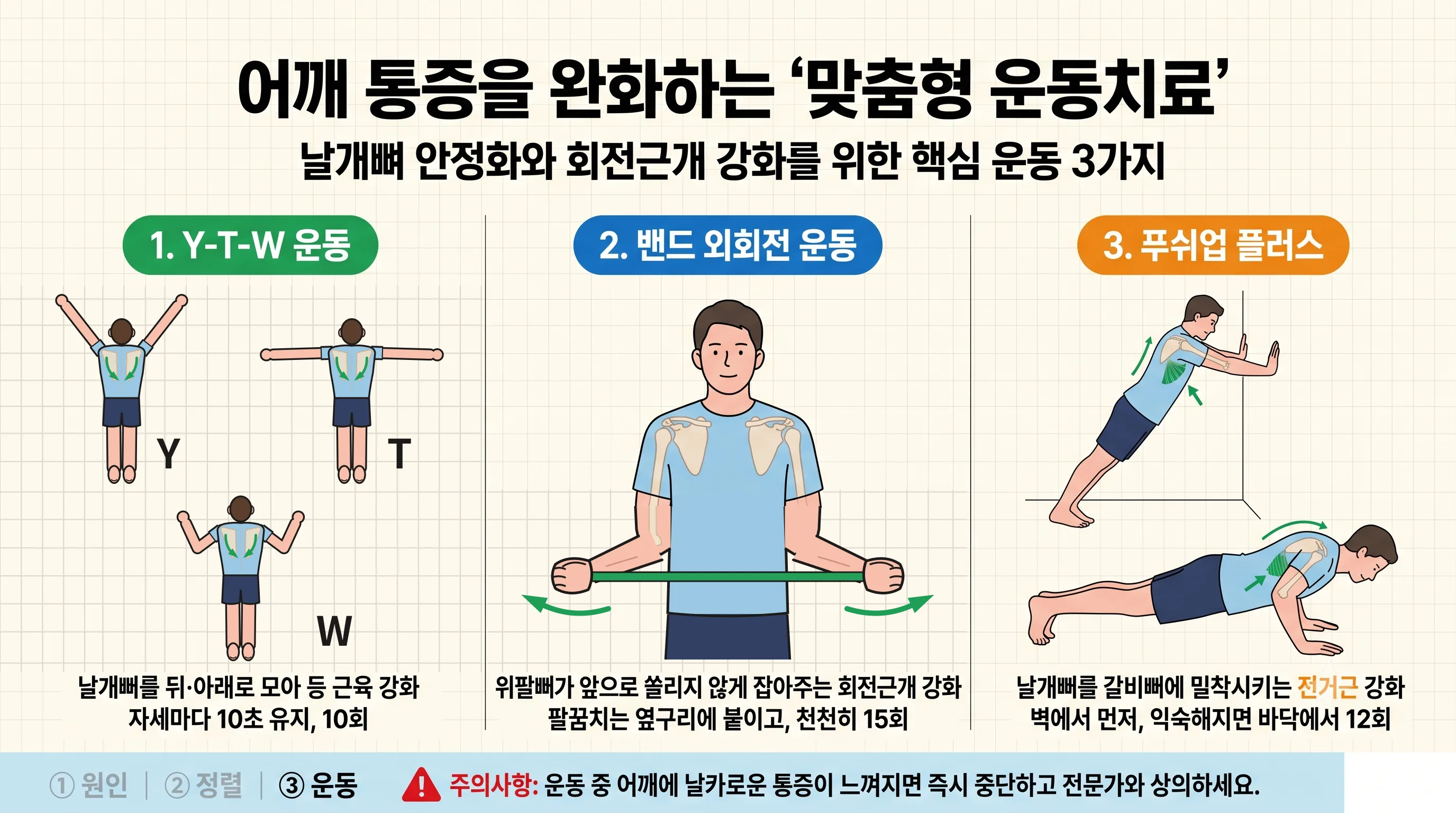
③ Exercise · three moves to wake up the shoulder blade and rotator cuff. Go slowly within a pain-free range and stop at once if you feel sharp pain. Choosing the right exercise together after an examination is the safest approach. Tap the image to enlarge (text in Korean).
How we approach it at Sangsaeng Clinic
We do not look only at the painful front of the shoulder; we look for what is pushing the ball forward. AK muscle testing identifies which of the muscles holding the shoulder have weakened, and we also check tension in the back of the capsule and fascia and the alignment of the upper back and neck. Based on the findings, we reposition the head of the upper-arm bone with Chuna and release the surrounding tissue with myofascial release and acupuncture. Right after treatment, we test the same muscles again and review the change with you.
FindAK testing for weak muscles; upper-back and neck alignment
CorrectChuna to reposition the humeral head
ReleaseMyofascial release and acupuncture
ConfirmRe-test the same muscles right after
In Korean medicine the front of the shoulder is where the Lung Meridian of Hand-Taiyin passes. People who breathe shallowly with a chest that is always drawn in tend to stiffen at the front of the shoulder, so we include meridian flow and breathing habits in treatment.
See a hospital first if: you cannot lift your arm after a fall or blow, the shoulder feels as if it has come out, the whole arm is numb or weak, or the shoulder is hot, swollen and painful. Left shoulder or chest pain with shortness of breath or cold sweat may be a heart problem — call 119 (Korea’s emergency number) right away.
Sahrmann SA. Diagnosis and Treatment of Movement Impairment Syndromes. Mosby; 2002.
This column is general health information and does not replace individual diagnosis and treatment.
Rhinitis2026.104 min read
Why sneezing and a runny nose hit every morning
If you start sneezing and reaching for tissues the moment you wake up, it is worth looking first at what happens inside your nose overnight and at your bedroom environment.
Read the full column
Why it is worse in the morning
Dawn is the coldest time of day, and the moment you leave the covers your nasal lining suddenly meets cold air. Blood vessels inside the nose swell while you lie down, and the reaction can show all at once when you get up. Dust that builds up in bedding overnight and dry indoor air also make the lining more sensitive.
What you can do at home
Keep bedroom humidity at 40–60%.
Wash pillowcases and bedding in hot water every one to two weeks.
After waking, sip warm water slowly and avoid breathing in cold air right away.
Avoid cold drinks and large meals just before bed.
How Korean medicine sees it
In Korean medicine the nose is where the meridian of the large intestine, the partner of the lungs, passes. So for people whose runny nose lingers, we look beyond the nose to digestion and bowel habits and to the mucous membranes of the mouth and eyes. Depending on the examination, we use acupuncture and herbal medicine to restore the balance of the whole body.
See an ENT doctor first if: one side of the nose stays blocked or the discharge contains blood, a high fever or facial pain lasts more than ten days, or you completely lose your sense of smell.
This column is general health information and does not replace individual diagnosis and treatment.